If you have only one full day in Bangladesh’s capital, planning the right route can make a huge difference.
Dhaka is one of the world’s most energetic and densely populated cities. Historic landmarks, busy neighborhoods, modern architecture, religious sites, traditional food, and river life are spread across different parts of the city. Traffic can also turn a short distance on the map into a much longer journey.
That is why the best one day Dhaka city tour is not about trying to visit every famous attraction.
It is about experiencing the right places in the right order.
A well-planned day can take you from the modern architecture of New Dhaka to the narrow historic streets of Old Dhaka. You can explore Mughal heritage, important national landmarks, traditional neighborhoods, religious sites, local food, rickshaw culture, and the historic Buriganga River.
For first-time visitors, especially travelers visiting Bangladesh from the USA, a full-day itinerary provides one of the best introductions to the capital.
This guide will help you understand what you can realistically see, how to plan your day, and why combining Old and New Dhaka creates a more complete experience.
One Day Dhaka City Tour: Quick Answer
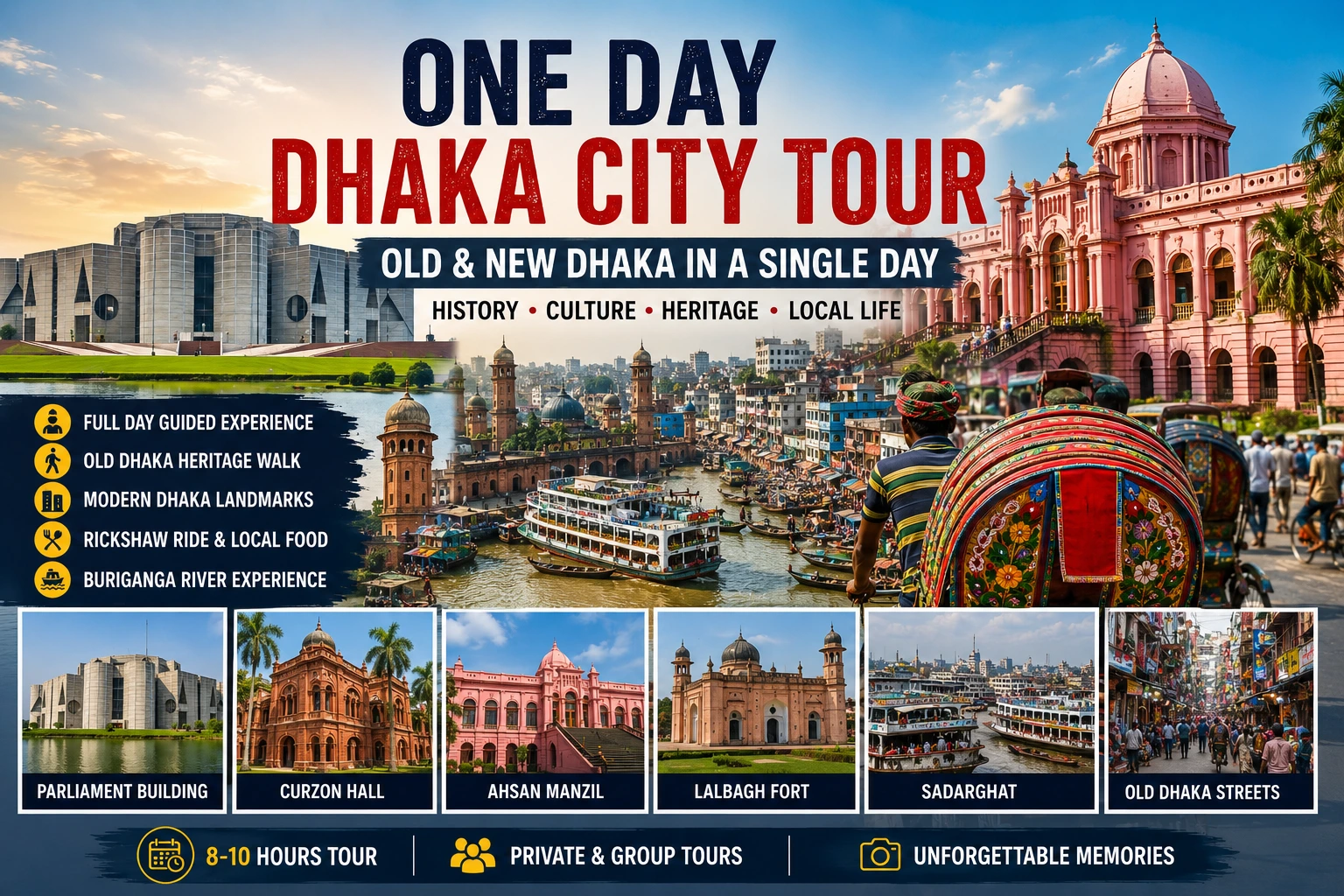
A typical one day Dhaka city tour takes approximately 8 hours, although the actual duration can vary depending on traffic, weather, attraction opening hours, and your preferred pace.
A balanced full-day itinerary may include:
- National Parliament Building
- Curzon Hall
- Central Shaheed Minar
- Dhakeshwari National Temple
- Lalbagh Fort
- Historic streets of Old Dhaka
- Star Mosque
- Shankhari Bazar
- Ahsan Manzil
- Sadarghat River Port
- Buriganga River
- Traditional rickshaw ride
- Bangladeshi food
The best itinerary combines both Old Dhaka and New Dhaka rather than focusing on only one part of the city.
This allows you to understand how Dhaka developed from an important historic trading and Mughal center into the modern capital of Bangladesh.
Why Explore Old and New Dhaka Together?
Dhaka is a city of contrasts.
Old Dhaka, locally known as Puran Dhaka, is filled with narrow lanes, traditional markets, historic neighborhoods, Mughal architecture, religious landmarks, colorful rickshaws, and centuries of cultural history.
New Dhaka presents another side of the city.
Here, you can see important government buildings, national monuments, universities, modern architecture, and areas that reflect the development of contemporary Bangladesh.
Exploring only one side gives you an incomplete picture.
A full-day Dhaka city tour allows you to experience both.
In the morning, you may see one of Bangladesh’s most important modern architectural landmarks. Later, you can walk through streets that have been shaped by Mughal rulers, merchants, artisans, religious communities, and generations of local residents.
That contrast is one of the biggest reasons to choose a one day Dhaka city tour.
The Best One Day Dhaka City Tour Itinerary
A Dhaka itinerary should always remain flexible.
Traffic conditions can change quickly, and some attractions may have specific opening hours or access restrictions.
However, the following itinerary provides a practical structure for experiencing the major highlights of Old and New Dhaka in one day.
Start Your Day Early
Starting early gives you the best opportunity to enjoy a full day without feeling rushed.
An early morning pickup from your hotel allows more flexibility before traffic becomes heavier.
Your itinerary may also need to be adjusted based on:
- Traffic conditions
- Attraction opening hours
- Weather
- Religious schedules
- Local events
- Your personal interests
This is particularly helpful for travelers who want to customize their experience.
Some visitors may be more interested in history and architecture. Others may want to spend additional time experiencing local food, photography, or everyday life in Old Dhaka.
A well-planned full-day experience should be flexible enough to adapt.
Visit the National Parliament Building
The National Parliament Building, also known as Jatiya Sangsad Bhaban, is one of the most important architectural landmarks in Bangladesh.
Designed by American architect Louis I. Kahn, the building is internationally recognized for its distinctive geometric design.
For travelers from the United States, the connection to Louis Kahn can make this stop particularly interesting.
The building also creates a strong contrast with the historic architecture you will later see in Old Dhaka.
Even an exterior visit can provide an excellent introduction to modern Bangladesh.
Its monumental design, open spaces, and geometric structure represent a completely different visual world from the narrow streets and dense neighborhoods of Puran Dhaka.
For architecture enthusiasts, this is one of the most memorable places to include in a one day Dhaka itinerary.
Explore Curzon Hall and the University Area
The University of Dhaka area is an important part of the city’s educational, political, and cultural history.
Curzon Hall is one of the most recognizable historic buildings in central Dhaka.
The wider university area has also played an important role in the development of Bangladesh’s intellectual and political identity.
This part of the itinerary creates a natural transition between modern Dhaka and the historic areas you will explore later in the day.
It also helps visitors understand that Dhaka is more than a collection of monuments.
The city has been shaped by education, political movements, cultural identity, and major historical events.
Visit the Central Shaheed Minar
The Central Shaheed Minar is one of the most important national monuments in Bangladesh.
It commemorates those who lost their lives during the Bengali Language Movement of 1952.
For international visitors, this stop provides important historical context.
The Language Movement played a significant role in the development of Bengali cultural identity and the history that eventually contributed to the creation of Bangladesh.
A guided explanation can make this visit more meaningful.
The monument represents much more than its physical structure.
It tells an important story about language, identity, sacrifice, and national history.
Discover Dhakeshwari National Temple
Dhakeshwari National Temple is an important part of Bangladesh’s religious and cultural heritage.
The visit also provides a broader understanding of Dhaka’s diverse historical identity.
Old Dhaka has been shaped by different religious communities, cultures, rulers, and trading networks over many centuries.
As you explore the city, you may encounter Islamic architecture, Hindu temples, colonial-era buildings, Mughal landmarks, and modern national monuments.
Dhakeshwari Temple is an important part of this larger cultural story.
Visitors should dress respectfully and follow local customs when entering religious spaces.
Explore Lalbagh Fort
Lalbagh Fort is one of the most important historical attractions in Dhaka.
The 17th-century Mughal complex provides a dramatic contrast to the busy streets surrounding it.
Inside the fort, visitors can explore historic structures, gardens, and open spaces while learning about Dhaka’s importance during the Mughal period.
The fort was never fully completed, and its unfinished history adds another interesting layer to the experience.
For first-time visitors, Lalbagh Fort is one of the best places to begin understanding Old Dhaka.
The surrounding area also provides a natural transition into the dense and historic streets of Puran Dhaka.
Travelers who want to spend an entire day focusing on this historic part of the city may also consider an Old Dhaka Tour.
Experience the Streets of Old Dhaka
The journey between famous landmarks is just as important as the attractions themselves.
Old Dhaka is not best experienced from inside a vehicle.
Walking through selected streets and using local transportation provides a much more authentic understanding of the area.
As you move through the historic neighborhoods, you may encounter:
- Traditional markets
- Small workshops
- Rickshaw traffic
- Street-food vendors
- Family-run businesses
- Historic buildings
- Local religious sites
- Everyday neighborhood life
This is where Dhaka begins to reveal its real personality.
Old Dhaka is not an open-air museum.
It is a living and working part of the city.
People live in these neighborhoods, run businesses, travel through the streets, visit religious sites, and continue traditions that have existed for generations.
The environment can feel intense for first-time visitors, but it is also one of the most memorable parts of a Dhaka city tour.
Enjoy a Traditional Rickshaw Ride
A rickshaw ride is one of the most memorable ways to experience Old Dhaka.
Rickshaws are an important part of the city’s identity.
A short ride through narrow streets allows you to experience the movement, sound, color, and energy of the neighborhood from a completely different perspective.
You are much closer to everyday life than you would be inside a private vehicle.
Rickshaws also help connect different parts of the itinerary without requiring visitors to walk long distances between every attraction.
For many international travelers, this becomes one of the unexpected highlights of the day.
Try Traditional Bangladeshi Food
After several hours of sightseeing, lunch provides an opportunity to experience another important part of Dhaka.
Depending on the location and your preferences, you may have the opportunity to try traditional Bangladeshi dishes such as:
- Kacchi biryani
- Tehari
- Kebabs
- Traditional rice dishes
- Bangladeshi sweets
- Lacchi
- Seasonal local snacks
Food is an important part of understanding Dhaka’s culture.
The city’s culinary traditions have been influenced by Mughal history, local ingredients, regional communities, and generations of family recipes.
Travelers who want to make food the main focus of their visit may prefer a dedicated Dhaka Food Tour.
For a full-day city experience, however, a traditional meal fits naturally into the wider cultural journey.
Visit Star Mosque
Star Mosque, also known as Tara Masjid, is one of the most visually distinctive religious landmarks in Old Dhaka.
Its decorative design makes it different from many other historic mosques in the city.
A visit to Star Mosque also demonstrates the architectural diversity found throughout Old Dhaka.
The city’s heritage cannot be explained through one historical period.
Mughal, colonial, religious, commercial, and modern influences all exist within relatively close proximity.
When visiting active religious sites, travelers should always follow appropriate etiquette and respect local customs.
Walk Through Shankhari Bazar
Shankhari Bazar is one of the most distinctive heritage neighborhoods in Old Dhaka.
The narrow street has a long association with traditional craftsmanship and the local Hindu community.
Walking through this area offers a different experience from visiting major monuments.
The narrow lanes, historic buildings, workshops, and everyday activity create a unique atmosphere.
It is also one of the most visually interesting parts of Dhaka.
Travelers with a specific interest in documenting local life may want to consider a dedicated Street Photography Tour in Dhaka, where there is more time to focus on photography and storytelling.
When taking photographs in residential or working neighborhoods, visitors should always remain respectful and avoid treating local residents simply as tourist attractions.
Discover Ahsan Manzil
Ahsan Manzil is one of Dhaka’s most recognizable landmarks.
Often called the Pink Palace, it was associated with the Nawabs of Dhaka and represents another important chapter in the city’s history.
Located near the Buriganga River, the palace also helps explain the importance of river trade and commerce.
For centuries, waterways played a major role in connecting Dhaka with other regions.
Ahsan Manzil connects several important elements of the city’s history:
- Architecture
- Trade
- Political influence
- River commerce
- Urban development
For many visitors, this becomes one of the highlights of the Old Dhaka section of the itinerary.
Experience Sadarghat River Port
Sadarghat is one of the busiest and most energetic areas of Dhaka.
The river terminal is filled with passenger boats, workers, traders, travelers, and constant activity.
For first-time international visitors, the experience can feel intense.
However, it provides one of the clearest views of Dhaka as a living and working city.
This is not a quiet tourist waterfront.
It is an important transportation and commercial hub.
A local guide can help visitors navigate the area and explain the role the Buriganga River has played in the history and development of Dhaka.
Take a Short Buriganga River Experience
A short experience on the Buriganga River can provide a completely different perspective on the city.
From the water, you may see:
- Passenger boats
- Commercial activity
- River transportation
- Waterfront communities
- Daily life along the river
- Dhaka’s historic connection with trade
The Buriganga River has played an important role in the development of Dhaka.
Seeing the city from the water helps connect the historical landmarks you have visited throughout the day.
After several hours on busy streets, the river can also provide a completely different atmosphere.
Can You Really See Old and New Dhaka in One Day?
Yes, but you need realistic expectations.
You cannot explore every museum, neighborhood, market, and historic attraction in detail.
The purpose of a one day Dhaka city tour is to experience the major contrasts that define the capital.
In one day, you can explore:
Old Dhaka
- Mughal heritage
- Historic neighborhoods
- Traditional food
- Religious sites
- Rickshaw culture
- River life
- Local markets
New Dhaka
- Modern architecture
- National landmarks
- Government buildings
- University areas
- Cultural monuments
- Urban development
Together, these experiences provide an excellent introduction to Dhaka.
If you have additional time, you can return to individual neighborhoods and explore them more deeply.
How Long Does a One Day Dhaka City Tour Take?
A full-day Dhaka city tour generally takes around 8 hours.
However, some itineraries may extend to 9 or 10 hours depending on traffic, attraction opening hours, weather, and the pace of the group.
Traffic is one of the biggest factors when planning a Dhaka itinerary.
For this reason, a good itinerary should not be completely rigid.
A knowledgeable local guide can change the route if:
- Traffic becomes unusually heavy
- An attraction has limited access
- Weather conditions change
- A religious site is temporarily unavailable
- You want to spend more time at a particular location
This flexibility can make a significant difference when you only have one day to explore the city.
One Day Dhaka City Tour vs. Half-Day Tour
The right choice depends on how much time you have.
A Half-Day Tour Dhaka can be a good option for travelers with a short stopover, business commitments, or limited availability.
However, a half-day experience usually requires you to focus on selected highlights.
A full-day itinerary provides more time to combine Old and New Dhaka.
It also allows you to experience the city at a more comfortable pace.
For first-time visitors to Bangladesh, a full-day experience usually provides a broader introduction to the capital.
Guided Tour vs. Exploring Dhaka Independently
It is possible to explore Dhaka independently.
However, doing so efficiently in one day requires careful planning.
Exploring Independently May Be Suitable If You:
- Have several days in Dhaka
- Enjoy navigating unfamiliar cities
- Are comfortable using local transportation
- Prefer a completely flexible schedule
- Have already researched the major attractions
A Guided Dhaka City Tour May Be Better If You:
- Are visiting Dhaka for the first time
- Only have one day
- Want to understand the history behind each attraction
- Prefer organized transportation
- Want help navigating Old Dhaka
- Want an English-speaking guide
- Prefer a flexible itinerary
- Want to experience heritage, food, culture, and local life efficiently
The value of a local guide goes beyond transportation.
A knowledgeable guide can explain why a place matters, provide cultural context, adjust the route based on traffic, recommend appropriate food, and help you discover details that may otherwise be easy to miss.
One Day in Dhaka for US Travelers
For travelers visiting from the United States, Dhaka may feel dramatically different from most American cities.
The streets are busier.
Traffic is more intense.
The city is denser.
The sounds, colors, and movement can feel overwhelming during the first few hours.
That difference is part of the experience.
The best approach is to arrive prepared and keep an open mind.
Wear Comfortable Walking Shoes
Even when transportation is included, you will spend time walking.
Historic streets can be narrow, crowded, and uneven.
Comfortable shoes are important.
Dress for the Weather
Dhaka can be hot and humid.
Lightweight and breathable clothing is generally the most comfortable choice.
Modest clothing is also recommended when visiting mosques, temples, and other religious sites.
Stay Hydrated
Carry water, particularly during warmer weather.
A full-day sightseeing itinerary can involve significant time outdoors.
Keep Your Schedule Flexible
Avoid planning an important flight, meeting, or long-distance journey immediately after your tour.
Traffic conditions can affect travel times.
Carry Some Local Currency
Bangladeshi Taka can be useful for small personal purchases.
Respect Local Customs
Ask before taking close photographs of people.
Follow your guide’s advice when visiting religious, residential, or sensitive locations.
What Should You Bring on a Dhaka City Tour?
You do not need to carry much.
A lightweight bag with the following essentials is usually enough:
- Comfortable walking shoes
- Lightweight clothing
- Sunglasses
- Sun protection
- Water
- Smartphone or camera
- Small amount of Bangladeshi Taka
- Personal medication if needed
Avoid carrying unnecessary valuables.
A lighter bag is more convenient when moving between vehicles, walking areas, rickshaws, and boats.
How Much Does a One Day Dhaka City Tour Cost?
The price of a one day Dhaka city tour can vary depending on several factors.
These include:
- Private or shared experience
- Number of travelers
- Transportation
- Entrance fees
- Meals
- Guide services
- Hotel pickup and drop-off
- Rickshaw rides
- Boat experiences
- Itinerary customization
The cheapest option is not always the best value.
When comparing tours, check exactly what is included.
Some lower-priced experiences may exclude:
- Entrance fees
- Lunch
- Transportation
- Hotel pickup
- Rickshaw fares
- Boat rides
A more complete experience may provide better value, particularly for first-time visitors who want a smoother and more organized day.
Always confirm the latest price and tour inclusions before booking.
Why a Full-Day Dhaka City Tour Is Worth It
Dhaka can be difficult to understand if you only see one small part of it.
A full-day experience provides a much broader perspective.
You may begin with modern architecture and landmarks connected to Bangladesh’s national identity.
Later, you move through areas shaped by centuries of history.
You explore Mughal heritage, traditional neighborhoods, religious landmarks, local food, rickshaw culture, and the historic river that helped shape the city.
By the end of the day, the attractions begin to connect.
You start to understand how the different parts of Dhaka relate to one another.
That is the real value of a one day Dhaka city tour.
It is not simply about visiting more attractions.
It is about understanding the city as a whole.
Extend Your Bangladesh Journey Beyond Dhaka
One day in Dhaka provides an excellent introduction to Bangladesh, but there is much more to explore beyond the capital.
Travelers interested in history can continue with an Old Dhaka and Sonargao Tour and experience historic destinations such as Visiting Panam City.
Nature lovers may prefer the tea gardens and green landscapes of a Sreemangal and Sylhet Tour.
Travelers interested in wildlife and heritage can consider a Sundarbans and Bagerhat Tour or explore the country through World Heritage and Historical Places Tours.
The right experience depends on how much time you have and what type of journey you want.
However, for many first-time visitors, starting with a full day in Dhaka provides the foundation for understanding Bangladesh.
Is a One Day Dhaka City Tour Worth Booking?
If you only have a short time in Bangladesh’s capital, a full-day tour can be an excellent choice.
It allows you to experience both Old and New Dhaka without spending your entire day trying to understand transportation routes, traffic patterns, and attraction locations.
You can experience:
- Mughal history
- Modern architecture
- National landmarks
- Religious heritage
- Traditional neighborhoods
- Local transportation
- Bangladeshi food
- River life
The day may be busy.
The streets may feel intense.
Traffic may require changes to the original route.
But those realities are part of Dhaka.
A well-planned experience should not try to hide the city’s energy.
It should help you experience it in a more meaningful and manageable way.
You may not see every corner of Dhaka in one day.
But you can experience the contrasts that make Bangladesh’s capital one of the most fascinating cities in South Asia.
FAQ
Is one day enough to visit Dhaka?
Yes. One day is enough to experience the main highlights of both Old and New Dhaka. You will not be able to explore every attraction in detail, but a well-planned full-day itinerary can provide an excellent introduction to the city’s history, culture, architecture, food, and local life.
What is the best one day Dhaka city tour itinerary?
A balanced itinerary can include the National Parliament Building, Curzon Hall, Central Shaheed Minar, Dhakeshwari Temple, Lalbagh Fort, historic streets of Old Dhaka, Star Mosque, Shankhari Bazar, Ahsan Manzil, Sadarghat, and the Buriganga River.
How long does a one day Dhaka city tour take?
Most full-day Dhaka city tours take approximately 8 hours. Depending on traffic, attraction opening hours, weather, and the pace of the group, some tours may take longer.
Can I visit Old and New Dhaka in one day?
Yes. A full-day itinerary can combine major highlights from both Old and New Dhaka. The route should remain flexible because traffic can affect travel times.
What is the best time to start a Dhaka city tour?
Starting early in the morning is generally the best option. An early start provides more flexibility and gives you more time to explore the city before the end of the day.
Is a guided Dhaka city tour worth it?
A guided tour can be especially valuable for first-time visitors. A local guide can provide historical context, help navigate busy streets, adjust the itinerary based on traffic, and make the experience more efficient.
How much does a one day Dhaka city tour cost?
The cost varies depending on whether the tour is private or shared, the number of travelers, transportation, entrance fees, meals, and other inclusions. Always check the latest price and confirm what is included before booking.
Is Dhaka safe for American tourists?
Travelers should follow normal urban travel precautions, including keeping valuables secure and staying aware in crowded areas. A knowledgeable local guide can make navigating a busy and unfamiliar city more comfortable.
What should I wear on a Dhaka city tour?
Wear lightweight, comfortable clothing and good walking shoes. Modest clothing is recommended when visiting mosques, temples, and other religious locations.
What should I bring for a one day Dhaka tour?
Bring comfortable shoes, water, sun protection, a camera or smartphone, a small amount of local currency, and any personal medication you may need.
Does a full-day Dhaka tour include food?
Some tours include lunch or local food experiences, while others do not. Check the specific tour inclusions before booking.
Should I book a Dhaka city tour in advance?
Advance booking is recommended if you want a private guide, hotel pickup, a customized itinerary, or a specific travel date.